

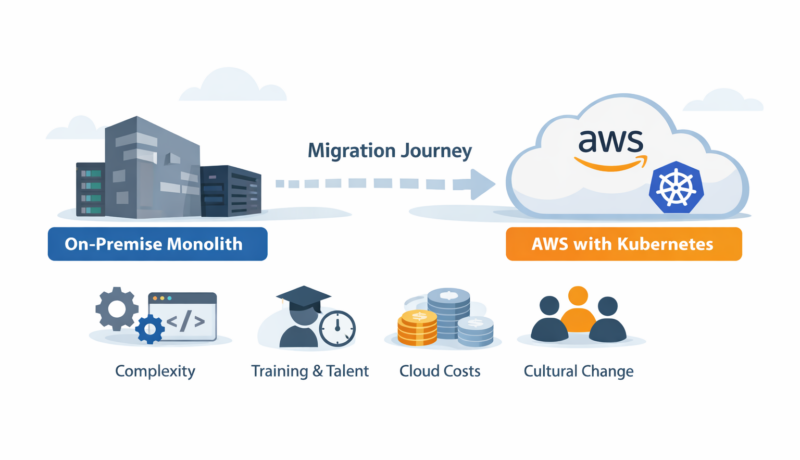
How to migrate On-Premise to AWS – The Real Cost of Migrating from a Monolithic On-Premise Infrastructure to AWS with Kubernetes

For years, many organizations have relied on monolithic architectures hosted on on-premise infrastructure. While this approach has proven stable, it often struggles to meet modern demands for scalability, agility, and rapid innovation.
Table Of Content
Moving to the cloud—especially to AWS using Kubernetes—offers a powerful alternative. However, this transition is far from simple, and the costs go well beyond infrastructure bills.
In this article, we break down what it really takes to make this shift and the true costs you should consider.
1. The Hidden Cost of Complexity
Migrating a monolith is not just about “lifting and shifting” to the cloud. It often requires:
- Redesigning the architecture
- Decoupling tightly integrated components
- Managing internal dependencies
Transitioning to microservices (a common pattern with Kubernetes) introduces new challenges:
- Service-to-service communication
- Distributed observability
- Handling partial failures
👉 Takeaway: You gain flexibility, but at the cost of increased complexity.
2. Time and Talent Investment
One of the biggest costs is your team:
- Training in AWS and cloud-native practices
- Learning Kubernetes and container orchestration
- Hiring or developing new roles (DevOps, SRE, Platform Engineers)
Additionally:
- Teams must adapt to new workflows (CI/CD, Infrastructure as Code)
- It takes time to build operational maturity
👉 Reality: The learning curve can take months—or even years.
3. AWS Infrastructure Costs
While AWS promotes a “pay-as-you-go” model, real-world costs can grow quickly.
Direct costs:
- Compute (EC2 nodes)
- Managed Kubernetes (EKS control plane)
- Storage (EBS, S3)
- Networking (Load Balancers, outbound traffic)
Indirect costs:
- Initial overprovisioning
- Underutilized resources
- Data transfer charges
👉 Important: Poorly optimized Kubernetes setups can cost more than on-premise.
4. Application Modernization Costs
Most monoliths are not ready to run in Kubernetes without significant changes:
- Containerization (e.g., Docker)
- Breaking the monolith into services
- Refactoring code
- Externalizing configuration
This often leads to:
- Partial or full rewrites
- Extensive testing
- Risk of introducing new bugs
👉 Translation: This is not just a migration—it’s a transformation.
5. Operational Costs (Day 2)
Once in production, new operational challenges arise:
- Monitoring (Prometheus, Grafana, etc.)
- Centralized logging
- Deployment management
- Security (IAM, RBAC, secrets management)
Also:
- Kubernetes cluster management
- Frequent updates and maintenance
- More complex troubleshooting
👉 Outcome: You need more advanced tooling and processes.
6. Cultural and Organizational Cost
This is often the most underestimated aspect:
- Shifting from “infrastructure-centric” to “platform-centric” thinking
- Empowering teams with more ownership
- Stronger collaboration between development and operations
Without this shift:
- Kubernetes becomes a burden instead of an advantage
👉 Key insight: Technology alone is not enough—culture must evolve too.
7. When Does It Make Sense?
Migrating to AWS with Kubernetes makes sense when:
✔ You need to scale rapidly
✔ Multiple teams are working in parallel
✔ You require high availability across regions
✔ Your business demands continuous delivery and agility
It may not be ideal if:
✖ Your system is small or stable
✖ Your team is not ready
✖ The business value does not justify the cost
Migrating from a monolithic on-premise system to AWS with Kubernetes is not just a technical upgrade—it’s a full transformation of your architecture, operations, and organization.
The costs span multiple dimensions:
- Financial
- Technical
- Human
- Organizational
The goal is not to avoid these costs, but to understand and plan for them strategically.
Final Recommendation
Start small:
- Migrate a single service first
- Validate your approach
- Learn before scaling
Because in projects like this, the biggest mistake is not overspending—it’s underestimating the true cost of the journey.


